
The Power of Being Listened to and Heard Deeply

The power of listening:
Being deeply heard can be transformative
I recently enjoyed a meal out with a friend and was looking forward to good food, good company and good old fashioned catch-up – what in Scotland, they might call a “blether”. Whether it was the music in the venue, the din of background noise, or perhaps my friend was having some issues with blocked ears, I don’t know. Either way, there was a lot of “pardon…..?” and “say that again”. I found myself feeling mildly frustrated, aware what I was saying wasn’t being heard. We quickly navigated the situation, with me speaking up so I could be understood. The overall experience, however, got me thinking about the power of listening, and the effect of being heard (or not).
In this blog, I want to gather some of my thoughts and reflections together on the power of listening and the therapeutic impact of being deeply heard and received in counselling. We’ll look at the qualities of powerful listening, the role and function of listening in therapy and explore some of the evidence for how deep listening can be so powerful. We’ll also consider the power of listening to yourself.
Listening to words and more
My work as a therapist involves listening deeply to what someone is saying, as well as what they may be feeling underneath the words. I’m listening to them through their verbal communication, of course. But I’m also listening to the slump of their shoulders, the tightening of their breath, or the unfinished sentence as they connect with emotion. There’s power in this listening!
In this blog, I’ll use the words “listen” and “listening” to refer to this myriad of ways we can receive another person. Rather than assume there’s only one way to communicate, I want to be open to the variety and diversity of how people communicate.
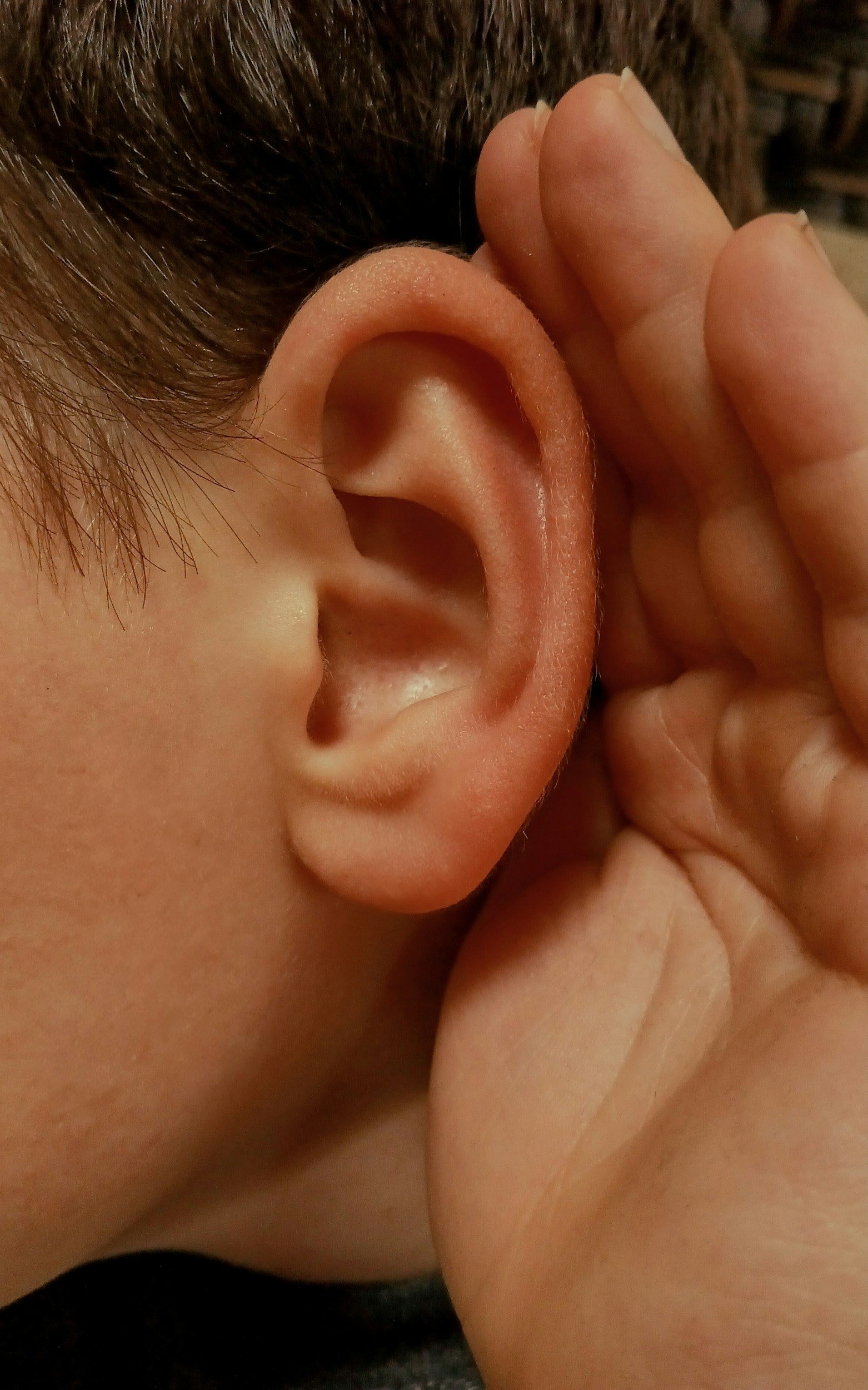
Listening, and listening well and deeply can be powerful
Of course, listening often involves our ears. But its also possible to receive someone in other ways, and “hear” what they are expressing though body language, gesture and facial expressions.
What does it mean to listen?
So, what is listening? I like to consider the etymology of words to get a better sense of their meaning. When I went in search of the origins of the word “listen”, I wasn’t disappointed. The word “listening” traces its origins back to Old English and the ancient Indo-European language family, where it originally carried a deeper sense of paying close attention. Listening, then, is more than hearing – it is a giving of our attention and focus as we receive another person. Listening is an active process of meeting another in what and how they express who they are in the word. Listening involves receiving, processing, and assigning meaning to spoken words, tone, pitch and pace of expression, as well as non-verbal communication. Powerful listening goes far beyond simply hearing sounds.
The impact of feeling unheard

Consider the power of feeling unheard
How do you react when you don’t feel listened to, or you have a perception that you aren’t being heard? Your response to this question can help to understand the power of listening
One way to consider how powerful listening can be is to look at how it feels when you perceive that you’re not being listened to, or sense that you are being misunderstood.
Consider how you feel, or have felt, when:
You’re talking to someone and they are checking their phone as you speak
You’ve expressed yourself but what you said has been misunderstood, with the other person getting the “wrong end of the stick”
Your experience of life is overlooked or discounted. This can be because of unconscious bias or because society has decided that some voices are worth listening to over and above others.
You’re told that how you want to communicate is not acceptable – you must “put it in writing”, rather than chat it through with someone, for example.
You’re talking – but you are very aware the other person is impatiently looking for any opportunity to jump in, rather than listening to what you have to say. This is something Stephen Covey described in his book, The 7 Habits of Highly Effective People (1989) - "most people do not listen with the intent to understand; they listen with the intent to reply."
You experience the “Double Empathy Problem” - something I explore in depth in my article on negative feedback when you’re neurodivergent.
In these scenarios, it would be understandable if you felt frustrated, sadness and disappointment. In those moments, we can feel dismissed, disconnected, or alone. In all these examples, there is a barrier getting in the way of feeling heard deeply, and being received with thoughtful attention and a genuine desire to understand your perspective.
So, having recognised the negative impact of not feeling heard, let’s turn our attention to the qualities of powerful listening.
The qualities of powerful listening
Powerful listening goes beyond simply hearing. Hearing is automatic. Listening, however, is intentional. Deep, powerful listening asks us to be present, curious, and compassionate and set aside our own agenda or need to change someone. Powerful listening asks us to remain open to what we are hearing, rather than rushing to conclusions or judgement. Powerful listening means noticing not only the words being spoken, but also the emotions underneath them.

Powerful listening asks us to remain open to what we are hearing, rather than rushing to conclusions or judgement
It’s possible to distil some of the qualities of powerful, or effective, listening. Research (Kluger et al, 2021) has helped us to identify 3 features of powerful listening: attention, comprehension and relational components. Let’s consider each of these in turn:
1. Attention in powerful listening
Powerful listening involves giving good attention to the speaker. This is sometimes called our “undivided attention”. In a fast-paced world where distractions constantly compete for our attention, attentive listening is a precious thing!. It is one of the simplest ways we can show love and care to the people around us. Rather than being distracted by our own internal thoughts and feelings, or external things, giving good intention involves being present to the other person as far as we are able. Attention is an act of generosity – we lend our focus and attention to the other for a period of time and set aside distractions. Powerful listening can be supported by shutting down distractions, putting away devices, and focusing entirely on the person in front of you This is sometimes called “bracketing” – we choose to bracket out other people, other pursuits, other interests in that moment to make ourselves available for the other.
2. Comprehension in powerful listening
Powerful listening is not a passive experience in which one person talks, and the other doesn’t. Powerful listening involves active engagement that shows we are present and seeking to comprehend.
Comprehension refers to the extent to which a person listening can convey that that have heard and understood the speaker. It relates to the way we show we’ve “got it”. This can be done non-verbally – eye contact and body language can support a sense of “message received and understood”. Verbally, we can summarise and reflect what we think we’ve heard to check out our comprehension and also convey our understanding, to support a sense of feeling understood. Periodically summarising or asking open-ended questions to confirm you've understood what a person means, rather than just hearing the literal words, can help show you comprehend a person.
3. Relational components in powerful listening
Relational aspects of powerful listening are about the relationship we have towards and with the speaker. This can include our intention and purpose for listening. When we listen with a non-judgemental, empathic and accepting attitude and stance – seeking to understand, rather than to ask someone to be any different, our listening is powerful. In practice, this means listening to understand a person rather than immediately trying to "fix" their problem or offer unsolicited advice. When someone listens well, they offer us a space where we do not need to perform, explain ourselves perfectly, or hide parts of who we are. This way of listening can contribute to a “virtuous circle” – as we listen to understand, the sense of relational safety between speaker and listener can increase - building trust and strengthening your relationship (Lee et al, 2024).

Poweful listening has 3 compontments:
Attention
Comprehension
Relational dynamics
I see you, I get you, I choose you
A simple way I like to use as shorthand to express these three aspects of powerful listening is: “I see you, I get you, I choose you”. When I am deeply listening, I am choosing to give a person my attention. I am seeking to see (and hear them) is as much of their fullness as they can show to me, and I want to understand them, and convey that I have understood. I like the phrase, “I see you, I get you, I choose you”, as a handy way to encapsulate the deep need we have as humans to be seen, got and chosen. Carl Rogers, the founder of person-centred counselling, said that when we listen in order to see and get a person, rather than to direct or control them, it’s the “most potent available agent of change” (1957) and “one of the most potent forces for change that I know” (1980). Powerful listening allows us to experience being seen, got and chosen which is, indeed, powerful stuff!

Powerful listening:
In a nutshell, where we have the experience of feeling seen, got, chosen
Powerful listening as therapeutic
Counselling and psychotherapy rely on the power of listening. There is therapeutic power in being truly heard at depth. In my counselling practice, I aim to listen deeply, offering my attention and presence – often to people expressing thoughts and feelings that they haven’t spoken aloud before. Listening attentively, with compassion, acceptance and empathy can be transformative and is at the heart of person-centred approaches to counselling. Rogers wrote:
“When you are in psychological distress and someone really hears you without passing judgement on you... it feels damn good!" — Rogers (1980).

Rogers, founder of person-centred therapy reflected that when someone really hears you without passing judgment on you...
it feels damn good!
Being listened to consistently and without judgement can begin to soften feelings of shame and isolation and clients often comment “it helps to say these things out loud, and be heard”. There is a surprising kind of clarity that can emerge when we speak openly in a safe space. Thoughts that once felt tangled begin to make sense. Emotions that felt overwhelming become easier to hold. In counselling and psychotherapy, powerful listening includes active listening not just to the words, but also the emotions and concealed feelings behind the words. In this way, powerful listening within therapy offers opportunity to understand more about yourself and what is going on for you under the surface and at the edge of your awareness. My listening is active and I am invested in the encounter as I listen – I am open and willing to be impacted and changed through the listening as I meet my client person at depth.
Communication barriers and needs in therapy
Listening within therapy includes, for me, attending to communication needs a person may experience. For some people, there are barriers to expression or cultural expectations about communication. I want to address any barriers by working in neuroaffirming ways, for example. I work in culturally sensitive ways so that we can collaborate on what supports feeling understood and safe enough to communicate.
Research on the power of listening in therapy
Whilst there are many different modalities (types) of therapy – what they all share is that good quality, active listening by the therapist is crucial to the work. Research shows that active and empathic listening in therapy builds a robust therapeutic alliance, validates emotions, and reduces defensiveness (Lee et al. 2024). Powerful listening can be very therapeutic. Powerful listening in counselling offers a place to feel heard, to feel understood, to feel safe and accepted.
The power of listening to self

I think it’s worth saying a few words about the power of listening to yourself. There is power in tuning into our own inner worlds of thoughts, feelings and sensations. Often, this ability to listen to self can be one of the outcomes of therapy
In a busy world, it is not always easy to find time for this inner paying attention. I believe there are benefits to listening to self in this way, however. For me, when I make space to listen to myself, I am more aware of my intentions and motivations, as well as my responses and reactions to situations. I have greater awareness of myself and the impact of my relationships with others and my environment upon me.
Having some prompt questions can be helpful if you want to practice the art of listening to self, and so I offer some reflective pointers below on questions you may like to ask yourself:
Prompts for honing the art of powerful listening to self:
How am I feeling right now?
What bodily sensations am I aware of in this moment?
If I could say anything right now, without fear for judgement, what are the words?
What has brought me joy today?
What has evoked fear in me today?
How satisfied am I with my relationship(s) recently? What would I like to change?
Next steps?
Perhaps these musings on the power of listening give you food for thought or inspire you to consider what listening means to you?

If you want to explore the power of being heard deeply within psychotherapy, you’re very welcome to make contact and enquire about my availability for new clients. Perhaps you have questions about the process or what psychotherapy involves. I’d be glad to listen to your questions and answer them openly and authentically.
I often have availability for either online therapy or face-to-face therapy in my counselling space in Preston. I welcome you making contact and we can discuss taking it from there.
References
Kluger AN, Malloy TE, Pery S, et al. (2021) Dyadic listening in teams: social relations model. Applied Psychology: An International Review 70(3): 1045–1099.
Lee, G. C., Platow, M. J., & Cruwys, T. (2024). Listening quality leads to greater working alliance and well-being: Testing a social identity model of working alliance. British Journal of Clinical Psychology, 63, 573–588.
Rogers, C. R., & Farson, R. E. (1957). Active listening. Industrial Relations Center, University of Chicago
Rogers, C. R. (1980). A way of being. Houghton Mifflin.