
What is Integrative Psychotherapy?
If you’re looking for counselling or psychotherapy, you may have encountered the term integrative psychotherapy and wondered what it actually means? The phrase integrative psychotherapy can sound complicated, daunting or clinical, but the idea behind it is actually very simple: it’s a flexible and personalised approach to therapy. Every person is different, and therapy can be tailored to a person’s wants, needs and preferences by integrating a range of approaches relevant to that individual.

In this blog, my aim is to provide a clear summary of what integrative psychotherapy is, and practically what it involves. We’ll explore some of the rationale and philosophy of integrative psychotherapy - including the importance of the therapeutic relationship in integrative psychotherapy. I'll share with you the specifics of my own practice as a BACP Senior Accredited integrative psychotherapist and what you can expect from me if you embark on integrative therapy with me, Claire Law. I’ll aim to address some common questions people have about integrative psychotherapy: but if you want to know more about the way I work, feel free to drop me a line.
Defining Integrative Psychotherapy
When describing integrative psychotherapy is, I find it helpful to begin with looking at the word “integrative”. The dictionary defines integrative as “to bring together separate parts or elements and combine them into a single, functioning, or unified whole”.

Integrative psychotherapy involves taking a range of therapeutic approaches and combining them within the counselling or therapy work
It is important these different approaches are combined into a unified whole
Integrative psychotherapy, then, involves taking a range of therapeutic approaches (sometimes called modalities) and combining them within the counselling or therapy work. What combines the approaches is the relationship between a client and therapist known as the therapeutic relationship. Effective integrative psychotherapy begins with the establishment and building of the therapeutic relationship, and it is this relationship that acts as the “unified whole”. This relationship acts as the container into which the therapist can draw from a range of therapeutic approaches that seem a good or best fit for the individual client.
The BACP (British Association for Counselling & Psychotherapy) - a membership body that accredits counsellors and psychotherapists defines integrative counselling as a form of therapy that “looks at the whole person, taking into account your mental, physical and emotional needs. Your therapist will use techniques and tools from different modalities to tailor an individual approach for you”. In other words, an integrative approach to therapy isn’t a “one size fits all” approach and doesn’t ask you to fit a single approach. Integrative psychotherapy is a holistic approach and will look and feel different for different clients. There’s plenty of scope for flexibility in the work, and for attending to individual preferences and needs from the counselling.
Another way to conceptualise integrative psychotherapy is to consider the overall aim of the approach - rather than a person feeling fragmented, or cutting themselves off from their own experience, the therapy can help a person to feel more whole, more unified - so that they can accept the various contradictions that live inside of them. This can involve making sense of how past experiences impact the present reactions and way of being in the world so you can make sense of difficult emotions. Integrative psychotherapy can promote a greater sense of wholeness or personal integration.
What does integrative psychotherapy involve?

We’ve explored some ways of defining integrative psychotherapy…..
But what does it actually involve? What happens in integrative psychotherapy?
To address the question of what integrative psychotherapy involves, it can be helpful to look at the work of Bordin (1979) who helped to articulate 3 important (and interlinked) aspects of Integrative psychotherapy: bond, goal and tasks. The bond refers to the therapeutic relationship. Goals are the mutually agreed-upon objectives and desired outcomes of the therapy. And the tasks are the ways in which client and counsellor work towards these goals. Let’s look at each of these in turn:
Bond:
As we’ve seen - it is the therapeutic relationship that is the basis of integrative psychotherapy. Initially, the therapy begins with the establishment of a therapeutic relationship to create a trusting bond between the therapist and the client. Research consistently shows that one of the most important parts of therapy is the relationship between the therapist and the client (Horvath & Symonds, [1991]; Martin, et al, [2000]).
Feeling safe, respected, and understood can make a significant difference in the therapeutic process. To support with establishing this supportive therapeutic relationship, the therapist will be transparent about practical aspects of the therapy, such as cancellation policies, and the importance of confidentiality in the work. They may attend to any accessibility needs or preferences the client may have. Likewise, keeping in mind a compassionate curiosity about a client, and what the client has experienced in their life, rather than operating from an assumption of “what’s wrong with you” is another way the integrative psychotherapist seeks to build a bond of safety, trust and connection.

The therapeutic relationship that is the basis of integrative psychotherapy
This relationship aims to offer trust, safety and connection
Goals:
As the therapeutic relationship begins to be established, client and counsellor can then collaboratively explore a client’s wants and needs from the integrative psychotherapy. This idea is sometimes described as identifying a client’s therapeutic goals - mutually agreed objectives and desired outcomes of the therapy. To help with this, the counsellor may offer the client some open-ended questions that support the client to elaborate what they are seeking in the work, so the therapist and client are “on the same page”. These questions may well be similar to some of the following:
What is it that you want to be different?
What has prompted you to seek therapy? And why now?
If the therapy was helpful, how would you know? What would look and feel different or better for you?
What are you looking for from me in our work together?

Collaborating and agreeing the focus, purpose and direction of the work is important in integrative psychotherapy
A therapist can help you in the process of articulating what it is you are looking for in and from the psychotherapy
Some clients aren’t initially sure about specific goals. It can be hard to translate vague feelings of dissatisfaction, or even overwhelming pain, into a clear objective. They might not know exactly what they want from integrative psychotherapy, but they do know they want to give the counselling a try. That’s why collaborating and the establishment of the therapeutic relationship is so important – a counsellor can support a client in any uncertainty they may have about the work so that, in time, a clearer direction and purpose emerge.
Examples of goals in integrative psychotherapy:
Whilst everyone’s therapeutic goals are unique to them, they may include themes such as:
To improve my self-esteem and feel more able to hold my head up high
To feel less impacted by grief and find ways to get through each day
To speak about feelings of disappointment and anger, and to feel a bit lighter
To understand why I feel stuck in patterns within relationships
To recover from burnout and find ways to live a more sustainable life
To work out how I can move on after a painful breakup
To feel less anxious so that I can socialise more
If you are considering integrative psychotherapy for yourself, it can be a helpful starting point to reflect on what it is you are wanting or looking for from the work to support you as you begin the therapy.
Tasks:
Once the therapeutic relationship has begun to form, and there is a collaborative agreement around the goals for the integrative therapy, the tasks, or the “how” of the therapy begins. The tasks can be thought of as the actual work the client and therapist agree to engage in during sessions to support movement towards the therapeutic goal.

The tasks of integrative therapy are the “hows” of the work
In integrative psychotherapy the tasks of therapy can be tailored to what will best serve the client in meeting their therapeutic goals
An integrative psychotherapist can offer a range of tasks, drawn from several different therapeutic approaches. They can and may explain the rationale behind the approaches they offer the client. For some clients, exploring techniques around relaxation or regulating the nervous system may be part of the work. For others, having space to speak freely and openly, and experience being deeply heard is a better fit for them. Some clients may want support in recognising patterns of behaviour or thought, and make links with how the past has influenced the present. In this way, the therapy is tailored to the client’s goals and their wants, needs and preferences. As with goal setting, the tasks of integrative psychotherapy are collaborative, and talking about how a client experiences the tasks, and what’s working for them is an important part of the therapy. This is sometimes called reviewing the therapy. This allows for client and counsellor to make changes and adapt the integrative psychotherapy as the work progresses.
The specifics of my own practice as an integrative psychotherapist.
Different therapists will integrate different approaches into their practice. Here, I want to outline some of the specific approaches that I integrate into my own psychotherapy practice.

Claire Law, Senior Accredited Integrative Psychotherapist based in Preston, Lancashire
My integrative psychotherapy practice draws on a wide range of approaches
If I were to describe my integrative practice as a list of ingredients, I would say something like: “Take a large cup of Person-Centred Counselling. Add a generous scoop of Gestalt Psychotherapy. Then, sprinkle in some or all the following: Existential Therapy, Transactional Analysis, Compassion Focused Therapy, Emotion Focused Counselling, Psychodynamic Therapy, Attachment Theory, Mindfulness &/or somatic and creative approaches to therapy”.
I’m aware that’s a long list! Full of lots of therapy jargon. And I’m unlikely to be drawing on all these ingredients at once. But each of the ingredients above do inform and influence my practice. Sometimes, I rely more heavily on one approach over and above the others. That’s the beauty of integrative psychotherapy – it allows for a tailored recipe for each client, built around what we’ve collaboratively agreed seems a good fit for the client and their unique needs. Sometimes, particularly when clients benefit from support in articulating what they want from our work, I may offer a tool called an “Inventory of Preferences” (Cooper & Norcross, 2016) which can help to nuance around what clients do and don’t want from our work.
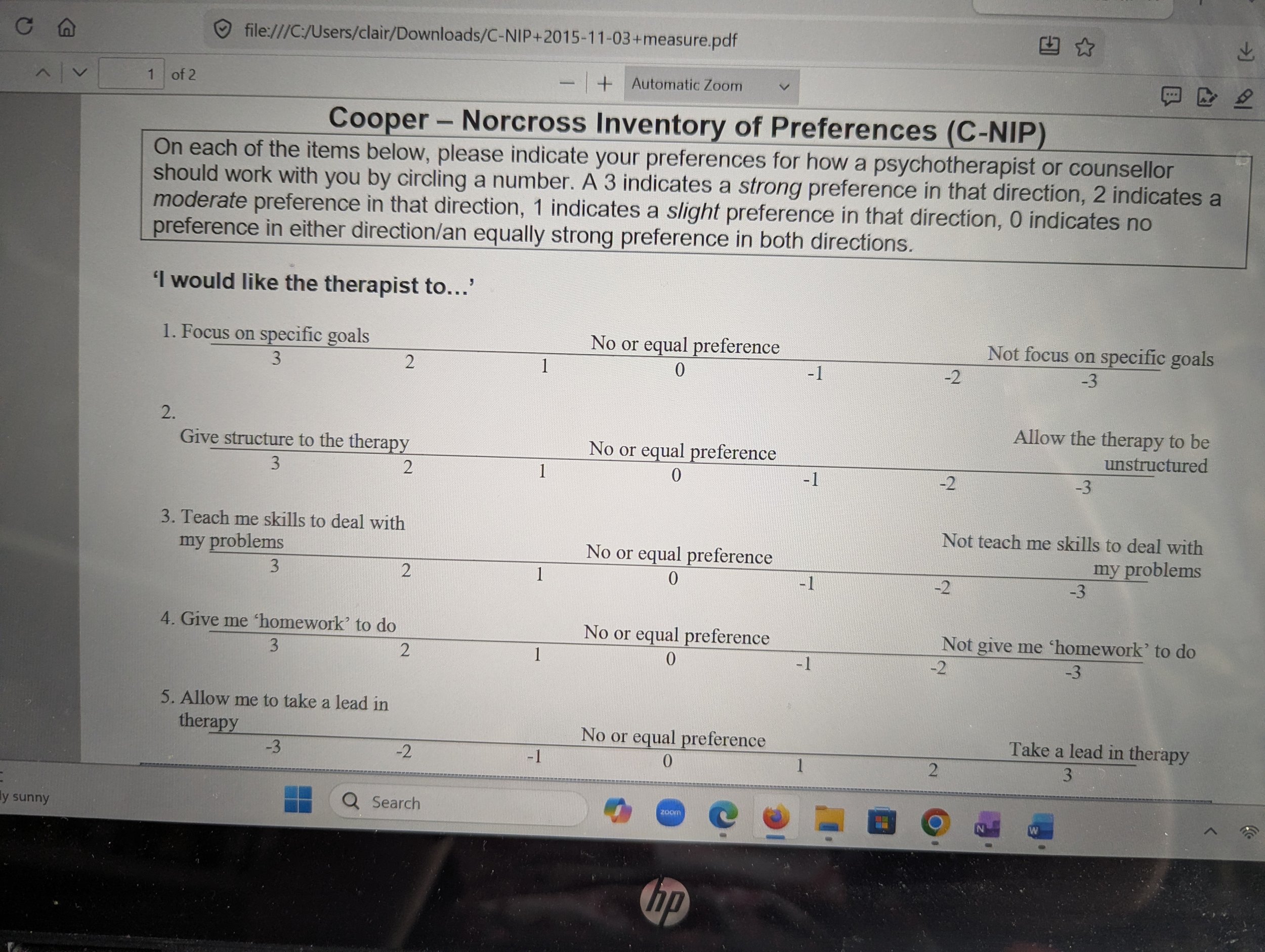
An inventory of preferences tool can help connect with your needs, wants and preferences from the integrative psychotherapy
So, to “flesh out” the ingredient list above, and to make them a bit less jargony - here a few words about each of the approaches that inform my practice:
Person-Centred Counselling:
An approach that believes that everyone has the capacity for personal growth and change, given the right conditions. Change is facilitated through the counsellor offering acceptance, empathy and genuineness to support you in feeling heard and understood.
Gestalt Psychotherapy:
An approach that seeks to relate to a client in their fullness and within their surroundings. The therapist will support you to focus on the here and now and your immediate thoughts, feelings, sensations and behaviours to better understand how you relate to others and to situations. Gestalt Psychotherapy can involve creative experiments to help raise awareness and gain new insight into your processes.
Existential Therapy:
Existential psychotherapy explores the inner conflict and anxiety that emerge from living with life's ultimate concerns, such as the inevitability of death, freedom and isolation. A therapist supports a client to find their own sense of meaning and to live well and embrace their choice and freedom.
Transactional Analysis:
This approach explores the relationships or “transactions” between people. It categorises human personality into three states – Parent, Adult and Child – to support you to understand how you interact with others and any recurrent and problematic patterns of behaviour.
Compassion Focused Therapy:
Compassion Focused Therapy supports clients to notice the self-critical ways they approach themselves, teaching people to replace harsh self-judgement with compassion, warmth and understanding in order to build healthy self-esteem and reduce shame.
Emotion Focused Counselling:
Emotionally focused therapy helps with understanding your own and others' emotions, so that emotions can become useful data about what you want and need, rather than states of being that need to be denied or suppressed.
Psychodynamic Therapy:
This includes exploring unconscious patterns and how past experiences, including childhood relationships, may influence present relationships and behaviours. Curiosity about the role of transference (where feelings you experienced in previous significant relationships can be projected onto the therapist) may be part of the work.
Attachment Theory:
This is a framework for understanding how early relationships can shape the way we connect with others.
Mindfulness:
Mindfulness is a practical approach to living in the present moment, raising awareness of what is. Mindfulness has been shown to support stress reduction, anxiety, and depression. It can also improve cognitive focus, emotional regulation, and pain management.
Somatic approaches to therapy:
This includes a range of theories and techniques that see the mind and body as deeply interconnected. Rather than relying solely on traditional talk therapy, these methods focus on physical sensations, movement, the breath and the nervous system to support with emotional regulation and processing trauma.
Creative approaches to therapy:
A way of working that allows for forms of expression in a variety of ways, including without using words. Collage, drawing, movement, model making or use of metaphor or analogy are some of the many ways clients can be supported to express themselves creatively.

Integrative psychotherapy is a careful combining of different therapeutic approaches
As with any good recipe, careful combining of ingredients matters when it comes to integrative psychotherapy. There’s no benefit in dumping lots of ingredients together – instead, the different approaches need to be blended and melded together in a safe and secure mixing bowl – the therapeutic relationship.
My hope then is that this blog has helped to explain in straightforward terms what integrative therapy is, what it involves and what to expect from me as an integrative psychotherapist.
Next Steps?

If you are interested in scheduling a free intro call to ask any questions you might have about starting integrative therapy, or to find out more about what integrative psychotherapy involves, I welcome you making contact with me, Claire Law, integrative psychotherapist, based in Preston, Lancashire.
I offer a simple, no-pressure approach to people who are considering therapy - and can chat through how I work, and to share with you my availability for new clients for either:
In person integrative psychotherapy at my therapy room in Preston.
Online integrative psychotherapy via MS Teams.
References:
Cooper M., Norcross J. C. A Brief, Multidimensional Measure of Clients' Therapy Preferences: The Cooper-Norcross Inventory of Preferences (C-NIP). International Journal of Clinical and Health Psychology. 2016;16(1):87-98.
Horvath A., and Symonds, D. (1991). Relation between Working Alliance and Outcome in Psychotherapy: A Meta-Analysis. Journal of Counseling Psychology 38, 2 (1991), 139–149.
Martin, D., Garske J., and Davis M. (2000). Relation of the Therapeutic Alliance with Outcome and Other Variables: A Meta-Analytic Review. Journal of Consulting and Clinical Psychology 68, 3 (2000), 438–450.
Modic, Karmen & Žvelc, Gregor. (2015). Helpful Aspects of the Therapeutic Relationship in Integrative Psychotherapy. International Journal of Integrative Psychotherapy. 6. 1-25.
Bordin, E. S. (1979). The generalizability of the psychoanalytic concept of the working alliance. Psychotherapy: Theory, Research & Practice, 16(3), 252–260.